
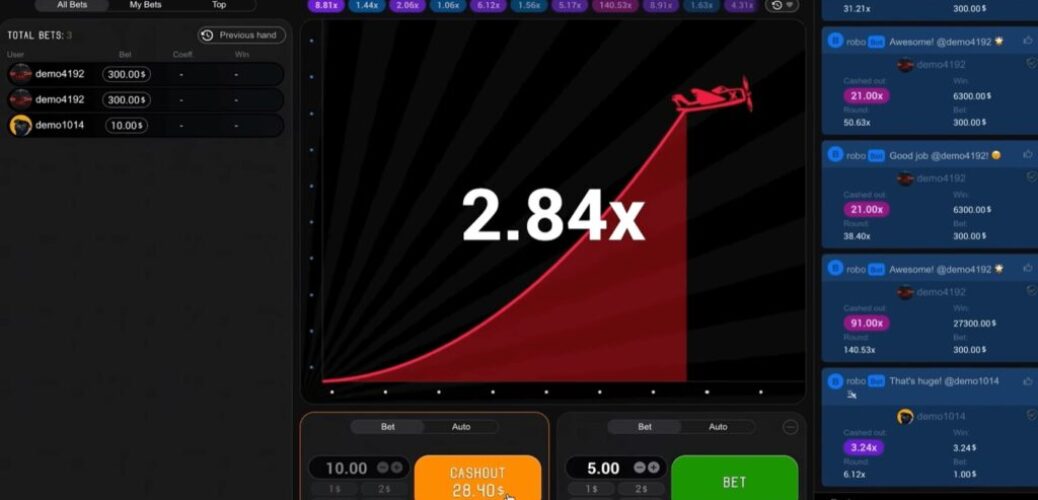
Aviator Two-Panel Play Explained
Aviator is a crash game by Spribe that uses an increasing multiplier and a crash point. Two-panel play lets one round carry two separate stakes, each with its own cash-out decision.
This guide explains how the panels work, why players split a stake, and how hedged and ride strategies change the timing of a cash-out. It also covers the published probabilities, the limits that depend on the operator, and the difference between managing variance and changing the game’s edge.
How Aviator Works
Aviator uses one increasing curve that can crash at any point in a round. Rounds usually last about 8-30 seconds, with 60-90 rounds available in an hour.
The game is a crash game and instant game, not a slot. It has no bonus round. Players place a stake before take-off, watch the multiplier increase, and cash out before the crash if they want a payout.
- A player selects a stake for a bet panel.
- The round starts and the multiplier rises from 1.00x.
- The player chooses a cash-out point during the rise.
- The payout equals the stake multiplied by the cash-out multiplier.
- A crash before the cash-out loses that panel’s stake.
The game shows the previous multipliers in the round history at the top of the interface. It also shows live bets through All Bets, My Bets and Top views, with Top able to show daily, monthly and all-time wins.
A provably fair system fixes the crash point before take-off. Before each round, the server publishes a SHA-256 hash of its server seed, while client seeds from players are combined with it. After the round, the inputs become available for checking through the verification tool inside the game.
That process means neither the operator nor Spribe can change the result after the round starts. It does not predict the next multiplier. Each round remains independent, so previous results do not create a pattern that changes the next probability.
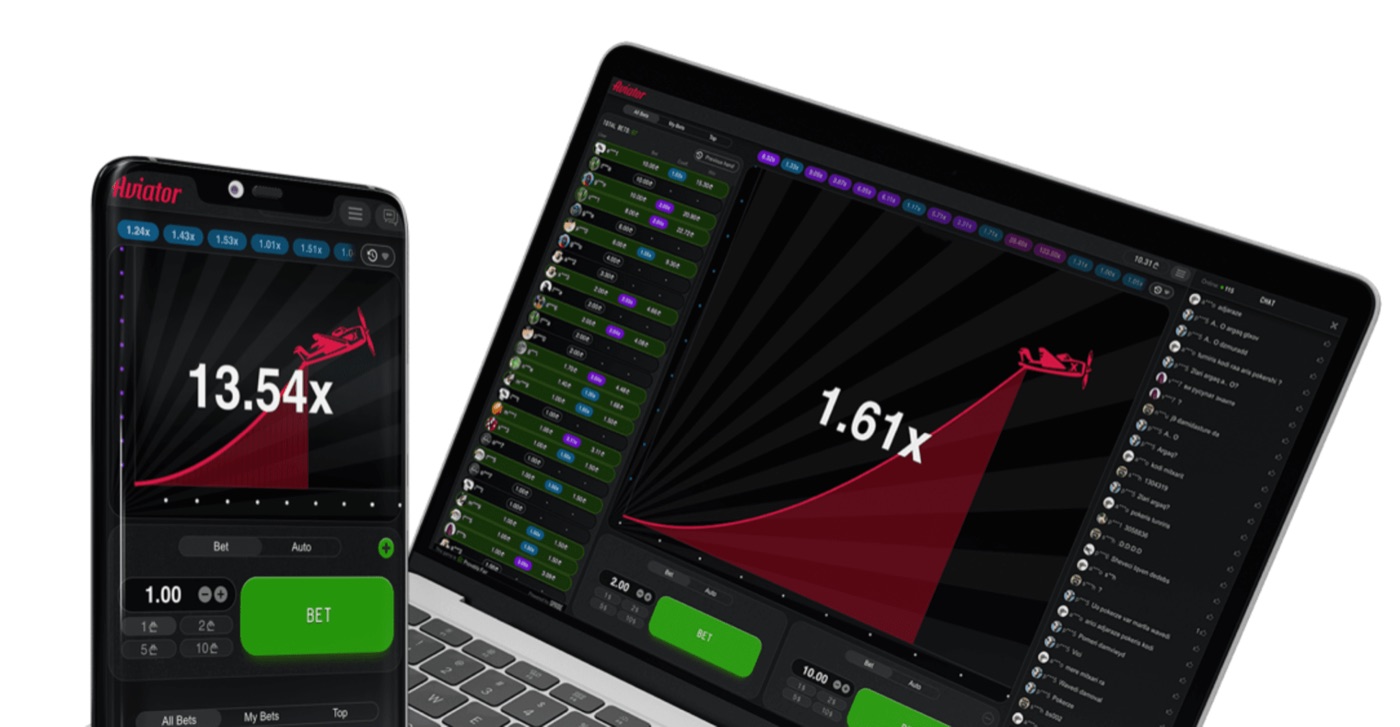
Aviator displays different live multipliers on a phone and a laptop.
Two Panels Explained
Aviator provides two bet panels in each round. Each panel has its own stake, cash-out action and result.
The two panels do not create two separate crash points. Both stakes face the same round multiplier, so a crash affects any panel that has not already cashed out.
A player can use the panels in several ways:
- Place the same stake on both panels and cash out both at one multiplier.
- Place different stakes and cash out both at separate multipliers.
- Cash out the first panel early while leaving the second panel active.
- Use one panel manually and set Auto Cash-Out on the other.
- Leave one panel unused when a single bet is enough for the intended plan.
For example, a player could place $10 on panel one and $10 on panel two. The first panel could cash out at 1.5x for $15, while the second remains active for a higher target. If the second panel reaches 5x before the crash, it pays $50. If the crash comes first, only the second panel’s $10 stake is lost.
The combined result in that example depends on the timing:
| Panel | Stake | Action | Example result |
|---|---|---|---|
| One | $10 | Cash out at 1.5x | $15 return |
| Two | $10 | Ride to 5x | $50 return if reached |
| Total | $20 | Two decisions | Depends on the crash point |
The two-panel feature does not double the mathematical return. It divides one round’s exposure into two decisions. A player can receive an early return from one panel while keeping some exposure to a larger multiplier on the other, but the second stake can still lose.
Typical stake ranges run from about $0.10 to $100 per bet, but the available amount depends on the operator. The maximum win per round also depends on the operator, and Spribe does not publish one universal maximum multiplier.
Separate Cash-Outs
Each Aviator panel supports a separate cash-out during the same round. The interface also includes Auto Cash-Out, which sends a panel’s cash-out at a preset multiplier.
A manual cash-out requires the request to reach the server before the crash. A time-out can result from latency or a slow device, so seeing a rising multiplier does not guarantee that a late request will settle first.
Separate cash-outs matter because the panels can follow different targets:
- Panel one can target 1.5x or 2x for an earlier exit.
- Panel two can target 5x or 10x for a longer ride.
- Both panels can use manual cash-out if the player wants direct control.
- One panel can use Auto Cash-Out while the other remains manual.
- A panel that crashes before its cash-out loses its own stake.
Auto Cash-Out removes one timing decision, but it does not guarantee that the target will be reached. If the round crashes below the preset multiplier, that panel does not cash out. The target must be reached before the crash for the automatic instruction to produce a return.
The interface also includes Auto Bet or Auto Play for 10-100 rounds. These tools can include stop-on-win and stop-on-loss settings, so a player can define when an automated sequence should end.
Automation changes how instructions are sent. It does not change the crash point, the published probability, or the 3% house edge. The same rule applies to a manual split between two panels.
For a crash game, cash-out is the central decision rather than a later settlement step. Anyone using two panels should check which panel is active, which target applies to it, and whether the requested cash-out has been confirmed.
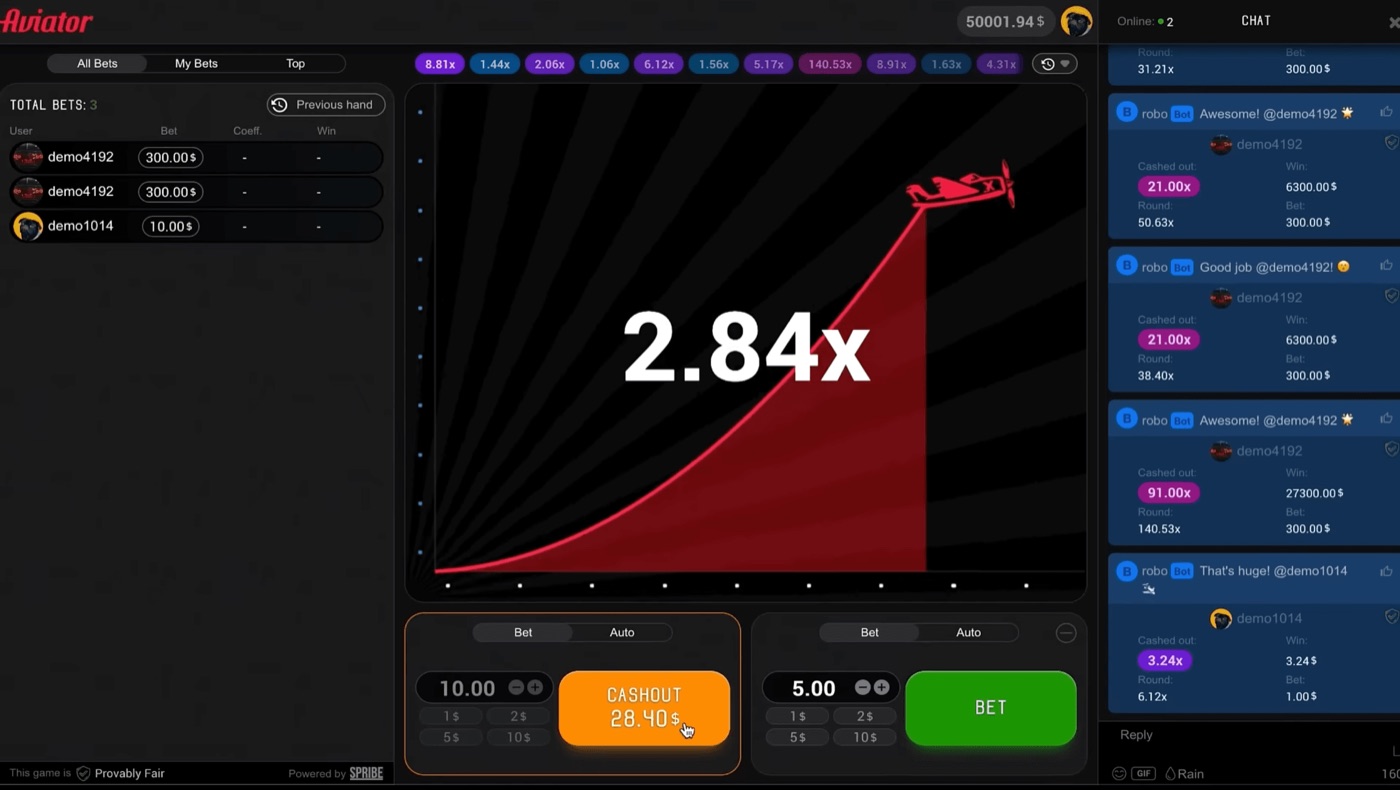
The Aviator interface combines live bets, chat and a cash-out at 28.40x.
Hedged And Ride Strategies
The two-bet split uses one panel for an earlier cash-out and one panel for a higher target. Guides commonly describe the first position as a safer bet and the second position as a ride.
A common split sets the first target at 1.5x-2x and the second target at 5x-10x. These targets do not remove the house edge, and the second panel can lose before reaching its target.
The purpose of the split is variance management. The first cash-out may return part of the combined stake in more rounds, while the ride panel creates exposure to a less frequent higher multiplier.
Consider two $10 stakes:
- Panel one cashes out at 1.5x, returning $15.
- Panel two stays active and targets 5x.
- If the round reaches 5x, panel two returns $50.
- If the round crashes at 3x, panel two loses its $10 because no cash-out occurred.
- If the round crashes at 1.2x, both panels lose if neither cashes out before the crash.
In the 3x outcome, the first panel returns $15 and the second loses $10. The two-panel result is a $5 return above the $20 combined stake, before considering other rounds. In the 1.2x outcome, the combined result is a $20 loss.
Players sometimes call the first panel a hedge because it can reduce the effect of a failed ride. It is not a guaranteed hedge in the financial sense. The first return may be smaller than the second stake, and both panels can lose on a fast crash.
Some guides suggest limiting a stake to no more than 2% of a bankroll per round. They also suggest setting loss and win limits, starting in demo mode, and treating the two panels as one combined round exposure.
Martingale does not improve this approach. It doubles the stake after each loss and reaches 1,024 times the base stake after 10 losses. Fibonacci and D’Alembert systems also do not overcome the 3% edge.
Responsible gambling means using only money set aside for entertainment and stopping when a personal loss limit is reached.
Numbers Behind Decisions
Aviator publishes a 97% RTP and a 3% house edge. The expected value is negative 3% of the stake at every cash-out target.
The probability that a round reaches multiplier m is 0.97 divided by m. The following figures show why a higher ride target occurs less often.
| Target | Probability of reaching it | Meaning for two panels |
|---|---|---|
| 1.2x | 80.8% | Earlier target with more frequent reach |
| 1.5x | 64.7% | Common early cash-out reference |
| 2x | 48.5% | About half of rounds reach it |
| 3x | 32.3% | Less frequent ride target |
| 5x | 19.4% | Longer target for the second panel |
| 10x | 9.7% | Infrequent ride target |
| 20x | 4.85% | Rare higher target |
| 50x | 1.94% | Rare long ride |
| 100x | 0.97% | Very infrequent target |
About 3% of rounds crash instantly at 1.00x, which is roughly 1 in 33 rounds. A 1.5x target may be reached more often than a 5x target, but the payout per unit stake is smaller.
The expected value remains negative 3% whether one stake cashes out at 1.5x or another stake rides to 10x. The split changes the distribution of wins and losses, not the mathematical edge.
For example, someone comparing a 1.5x cash-out with a 5x ride can use the reach probabilities rather than a pattern. A 1.5x target has a 64.7% reach probability, while a 5x target has a 19.4% reach probability.
Players searching for a practical explanation can find the phrase aviator game download play store alongside questions about a crash game, multiplier and cash-out. That phrase does not change how the game calculates a stake or result.
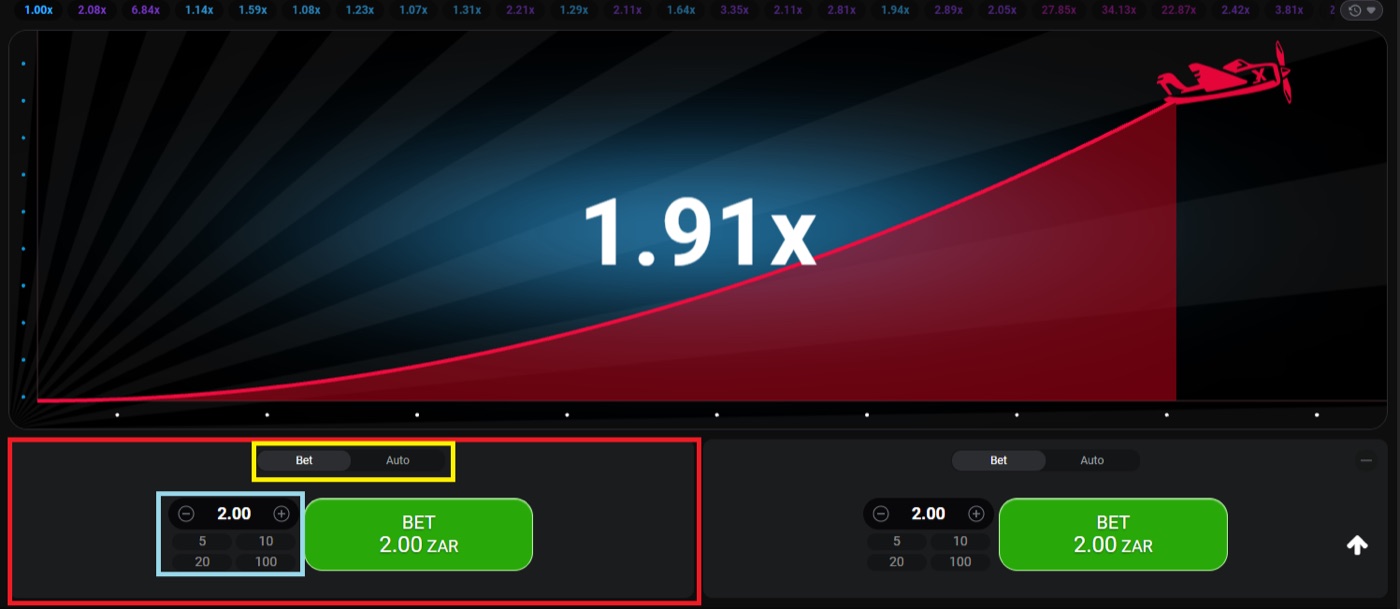
A desktop Aviator round shows 1.91x with two bet panels available.
Controls And Boundaries
Aviator includes Bet and Auto tabs for each betting panel. The interface also includes a Provably Fair badge, quick stake buttons, live bets, round history and in-game chat.
Demo mode is available through an operator or demo.spribe.io and requires no registration. The game works in desktop, tablet and mobile browsers and was built for low bandwidth and budget devices.
Useful controls include:
- Bet for manual stake and cash-out decisions.
- Auto for preset cash-out and automated rounds.
- Auto Cash-Out for a selected multiplier.
- Auto Bet or Auto Play for 10-100 rounds.
- Stop-on-win and stop-on-loss conditions.
- Round history for reviewing earlier multipliers.
These tools support a defined plan, but they cannot forecast a crash point. “Patterns”, graph analysis, a best time to play, and strategy chart PDFs do not change the odds. Playing off-peak may provide a smoother connection, but it does not improve the probability.
There is no standalone official Aviator app from Spribe. Aviator runs inside a licensed operator’s website or app, while applications using names such as Aviator Predictor are third-party products with virtual-coin or advertising disclaimers.
Prediction services cannot know the committed crash point before the round. The server hash commits the result, and public mathematics sold through signal bots does not provide a method to beat the 3% edge.
Limits and payment methods vary by operator. An operator may set the minimum stake, maximum win per bet, maximum win per round and available deposit method, so players must read the terms shown in the relevant Aviator interface.
Aviator FAQ
Aviator has two bet panels in each round. Spribe gives the game a 97% RTP and a 3% house edge.
The answers below focus on two-panel play, separate cash-outs and the limits of ride strategies. They do not treat a split stake as a way to predict or remove crash-game risk.
What does two-panel play mean?
Two-panel play means placing two stakes in one Aviator round. Each panel can use a separate cash-out, so one panel may exit early while the other remains active.
Can both panels cash out separately?
Yes. Each panel has its own cash-out action and can use its own Auto Cash-Out target. A panel that has not cashed out before the crash loses its stake.
Is the first panel a guaranteed hedge?
No. An early cash-out can return part of the combined exposure, but both panels can lose if the round crashes before either cash-out. The split changes variance, not the 3% house edge.
What targets do ride strategies use?
Guides commonly use 1.5x-2x for the earlier panel and 5x-10x for the ride panel. The probability of reaching 1.5x is 64.7%, while the probability of reaching 5x is 19.4%.
Can an app predict the second panel’s result?
No. The crash point is fixed before take-off through the provably fair process. A predictor cannot use previous rounds or a panel split to change that result.
Who sets Aviator’s stake and win limits?
The operator sets limits that can differ by betting site. Typical stakes range from about $0.10 to $100 per bet, but the available amount and win cap depend on the operator.