
Decoding PPV Density Signals on Free OnlyFans Pages
OnlyFans free pages look like the cheapest entry on the platform, but the $0 subscription hides the real cost model. Decoding PPV density signals means learning to read how often a creator sends locked content before you commit your attention and your wallet. This guide covers the mechanics, the ranking signals, and the budget math that turn an unpredictable free page into a forecast you can plan around, using the same reading approach BestOnlyFans applies to its ranking cards.
The messages are the product. A creator sending three locked messages a day runs a different business than one posting unlocked teasers and selling two unlocks a month.

How Free Pages Replace Subscriptions with PPV
Platform rules cap a single PPV unlock at $50, while paid chat commonly runs $3 to $5 per message and tips can reach $100. OnlyFans takes a 20% cut of every transaction, so the creator keeps 80%.
That structure changes creator incentives.
- Zero-dollar subscription entry with no monthly renewal
- Locked message function with unlocks up to $50
- Tip capability that can reach $100 per tip
- A 20% platform fee on all transactions, leaving the creator 80%
None of this is inherently bad. The point is that the free label describes the entry price, not the ongoing cost, and every budgeting decision downstream depends on recognizing that.
Tip: before subscribing to any free page, check whether the creator labels locked messages with a price and a description. Pages that preview what is inside each unlock tend to produce fewer accidental charges than pages that send blind locked media.
Reading Activity Metrics as PPV Predictors
Post frequency is the first signal: a page posting several times daily is likely running an active sales cadence, and active cadence correlates with message volume.
The media-to-post ratio matters just as much. A card dominated by media posts suggests a page where the media itself is the product, and on a free page that usually means locked media.
Like distribution is the third signal. When nearly all likes cluster on a handful of posts, the creator is concentrating attention on specific items, often the paid ones. Price history stability is the fourth: cards showing a consistent promo pattern are easier to forecast than cards with constant price changes, since frequent repricing often accompanies aggressive upsells.
- Post frequency: multiple daily posts point to an active sales cadence
- Media-to-post ratio: media-heavy cards suggest locked media as the core product
- Like distribution: clustered likes indicate concentrated paid pushes
- Price history stability: steady promo patterns are easier to forecast than constant repricing
- Activity freshness markers: recent, consistent timestamps suggest a currently active seller
In our own review process at BestOnlyFans, we weight freshness and price stability most heavily because those two change least often between checks.
Comparing PPV Strategies Across Page Categories
PPV density is not uniform across niches. Different categories settle into different rhythms, partly because production time differs and partly because audience expectations differ.
The table below maps the typical patterns. Treat the ranges as general tendencies rather than fixed rules, since individual creators vary widely within every category.
| Content Category | Typical PPV Frequency | Common Unlock Price Range |
|---|---|---|
| Lifestyle | High, near-daily locked messages | $3-$10 |
| Fitness | Moderate, several per week | $5-$15 |
| Cosplay | Low frequency, larger sets | $10-$30 |
| ASMR | Moderate to high, short clips | $3-$8 |
| Adult content | Variable, often high | $5-$50 |
The pattern to notice is that low-frequency categories often carry higher per-unlock prices, while high-frequency categories keep prices low and rely on volume. A page sending fifteen $5 unlocks and a page sending three $25 unlocks both land near $75 if you open everything.
Frequency multiplied by price is the number that matters, and it is the number most subscribers never estimate before the first month ends.
Building a Monthly PPV Budget Forecast
Most subscribers unlock more in the first two weeks and taper afterward, so a flat projection tends to overstate steady-state cost.
Average unlock prices cluster in the $5 to $10 band for most pages, so the projections below use $7 as a working midpoint.
| Activity Level | Estimated Monthly Unlocks | Projected Total Cost |
|---|---|---|
| Light | 2-5 unlocks | $14-$35 |
| Moderate | 6-15 unlocks | $42-$105 |
| Heavy | 16+ unlocks | $112 and up |
A single spreadsheet column per creator, updated weekly, catches that drift before it becomes a surprise.
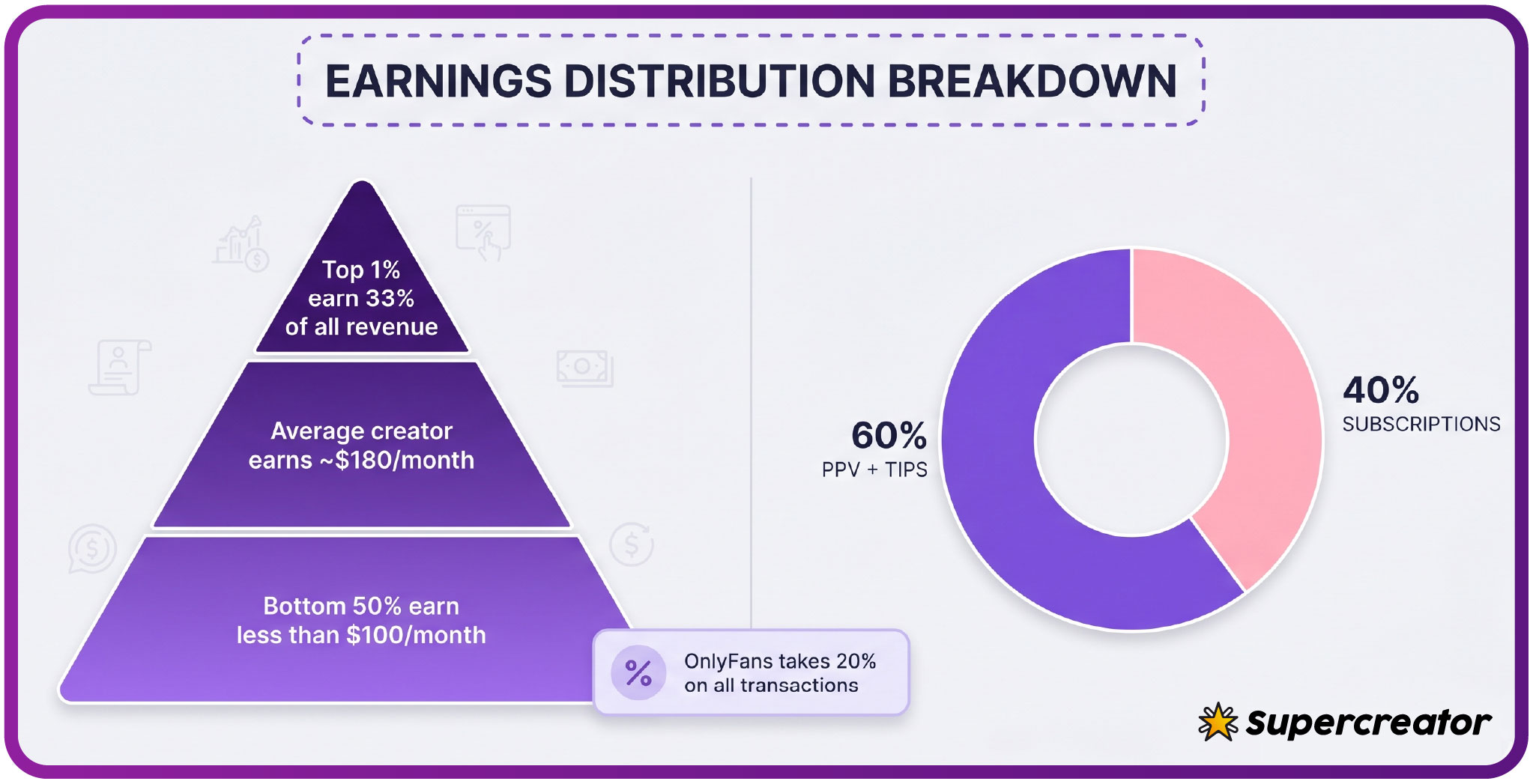
A small number of creators capture a large share of platform spending, and pages outside that group often compensate with higher message volume. That is a structural pressure, not a personal failing of any individual creator, but it does shape what lands in your inbox.
For anyone building the forecast, the practical step is to track two numbers per page: unlocks per week and average unlock price. Multiply them, then multiply by four. That single figure is your realistic monthly exposure, and comparing it against the $4.99 minimum subscription clarifies quickly whether the free entry is actually saving you money.
Spotting Warning Signs of Aggressive PPV
Aggressive PPV is not about price alone. It is about pressure applied in sequence. The signals below tend to appear in this order as a subscriber moves from casual follower to active buyer, which makes the early ones the most useful for early exit.
- Daily locked messages arriving without any labeling or preview
- Unlock prices climbing above $10 per message
- Tip requirements stated before the creator will reply
- Content available only as bundles, never as single unlocks
- Per-message costs that escalate week over week
- Limited-time pressure offers with short countdown windows
- Welcome sequences that stack several paywalls in the first days
The third item deserves emphasis. A tip requirement before a reply converts a conversation into a transaction, and once that norm is set it rarely reverses.
Warning: unsolicited messages asking you to move a conversation off-platform, verify your account through an external link, or confirm card details are a common fraud pattern, not a VIP perk. Legitimate creators do not need your card number in a direct message.
Card verification holds are a related area where confusion helps nobody. The standard verification hold is $0.10 and is refunded within days. Any page or third party requesting more than that for “verification” is not following the platform’s normal process, and that alone is a reason to stop. Recognising a common fraud pattern early is the same skill as reading PPV density: both come down to noticing structure before money moves.
When Free Pages Become More Expensive Than Paid
Paid subscriptions run from a $4.99 minimum to a $49.99 maximum, with most pages sitting in the $4.99 to $15 band. Promotional first months can dip below $4.99, sometimes to $3, but the base price itself cannot go under the minimum.
If your projected monthly unlocks on a free page exceed $15, a paid page in the typical range is usually the better deal, because the archive is open and the billing is predictable.
- Frequent unlockers spending over $15 monthly on a single free page
- Fans who want full archive access rather than message-by-message purchases
- Subscribers who prefer a fixed, predictable charge over variable billing
One mechanic strengthens the paid case further. When a creator raises a price, auto-renew stops, and existing access continues only until the paid period ends. That rule gives you a natural checkpoint, since the renewal decision returns to you rather than happening silently.
Free pages still win in specific situations. If you check in occasionally, unlock two or three items a month, and value the zero-commitment entry, the free model costs less than any subscription. The math only flips when volume rises, which is exactly what the density signals in this article exist to predict. Readers who want to compare page options side by side, including free onlyfans model accounts listed by activity pattern, can use those listings as a starting screen before running the forecast above.
Protecting Your Budget with Usage Limits
The steps below take about ten minutes total and cover most of the leakage points.
- Set a hard monthly PPV cap and write it down where you will see it
- Use a prepaid card loaded with a fixed amount for subscriptions and unlocks
- Review spending weekly against your bank statement rather than monthly
- Pause wallet auto-reloads so each top-up is a deliberate act
- Keep a running cost tracker per creator, updated after each unlock
Prepaid cards are the single most effective control, since the card balance enforces the limit for you. Pair that with a weekly review and most overspending disappears, because the pattern becomes visible while it is still small.
Account security belongs in the same conversation. Enable two-step authentication in account settings so a lost password does not become a lost payment method. Most credential theft targeting subscription platforms starts with a reused password, and a second factor stops that entire class of attack.

A subscription renews on a schedule until you cancel it, while a PPV unlock is a single charge with no recurring component. Most budget surprises come from treating the second like the first and forgetting that the first keeps running.
Cancellation dialogs usually ask why you are leaving, which is a useful prompt to note whether cost was the reason. If it was, the density forecast for that page was off, and the same signals that failed there are worth re-checking on the next page you consider.
FAQ
Why do free OnlyFans pages send so many locked messages?
A free page earns through PPV unlocks, paid chat, and tips, with the platform taking 20% of each transaction. High message volume is the direct consequence of a zero-dollar entry price, not a sign that something unusual is happening.
How can I tell if a free page will be expensive before I subscribe?
Read the external signals first: post frequency, media-to-post ratio, like distribution, price history stability, and activity freshness.
Does BestOnlyFans show which pages have the most PPV content?
Ranking cards can show activity patterns and pricing behavior, but no third-party site can see inside private messages. Use the cards as a screening layer that narrows your options, then confirm the actual density during the first week before committing to a monthly budget.
What is the maximum I might spend on a single free page in one month?
There is no platform cap on how many unlocks you can make, though each individual PPV unlock tops out at $50. At heavy engagement of sixteen or more unlocks and an average $7 price, a single page can exceed $112 monthly.